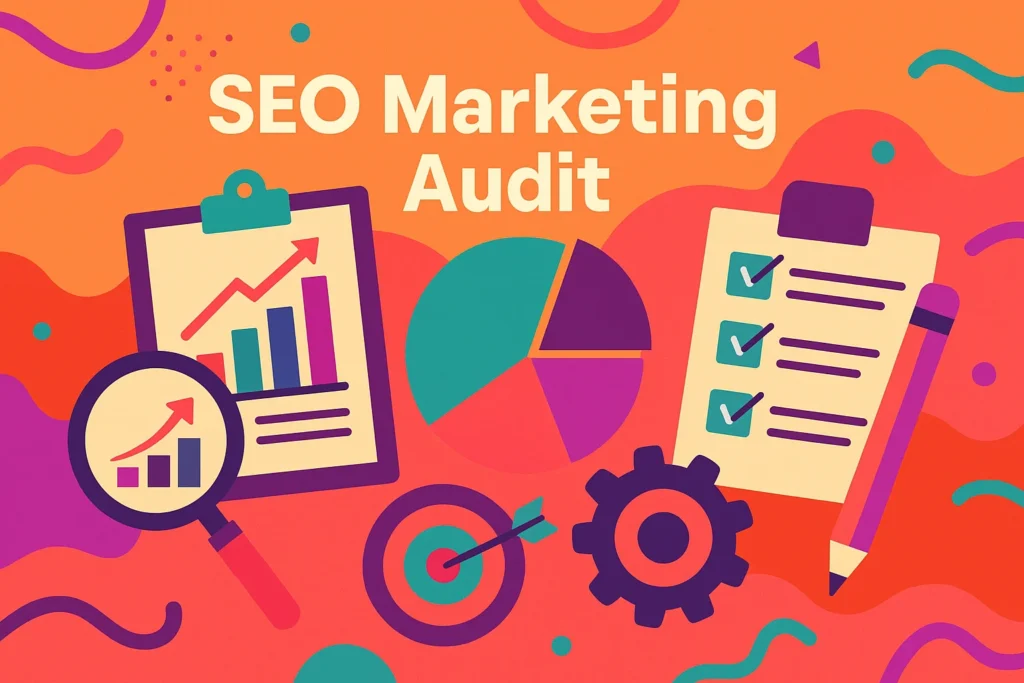
What Is an SEO Marketing Audit?
Let me break this down as simply as I can: a seo marketing audit is like a health check-up for your website. It’s the process of examining all the elements that affect your site’s performance in Google — from the technical backend to your content quality and backlinks.
At Vibe Branding, we’ve been doing these for over a decade, and every time we run one, we find gold. Not the shiny stuff, but the kind of insights that lead to better traffic, improved rankings, and actual business growth.
You’d be surprised how many businesses come to us with a sleek-looking website that can barely be found on search engines. That’s because SEO isn’t about how pretty your site is — it’s about how healthy and optimized it is behind the scenes.
An audit uncovers exactly what’s holding you back and gives you a roadmap to fix it.
TL;DR – Here’s What You’ll Learn
- What an SEO marketing audit really is and why it matters
- How to know when your website needs an audit
- What kind of problems an audit can uncover
- Tools and steps I personally use with clients
- What to fix first — and how long it takes to see results
- Mistakes to avoid after getting audit results
- The key metrics I track to measure real growth
How Do You Know If You Need an SEO Marketing Audit?
If your website traffic has been dropping, or your pages just aren’t ranking like they used to, it’s probably time. I’ve had clients who didn’t even realize they were missing out on thousands of potential visitors until we ran an audit.
Sometimes it’s slow page load speed. Other times it’s broken links or duplicated content.
But more often than not, it’s a combination of problems that add up over time. You might also need one if:
- You just launched a new website
- You’ve recently updated your content or backend
- You got hit by a Google algorithm change
- You’re investing in paid traffic, but not seeing returns
- Or — and this is a big one — you’ve never had one done
Trust me, every business should audit their website at least twice a year.
The Kinds of Problems a Good SEO Audit Will Uncover
Now, not all audits are created equal. A quick 5-minute scan isn’t going to tell you what you really need.
At Vibe, we go deep. We look at over 100 data points per site.
That’s how we uncover issues like:
- Pages that aren’t being indexed by Google
- Poor mobile experiences that hurt rankings
- Duplicate pages causing keyword confusion
- Spammy backlinks dragging down authority
- And even hidden technical problems that slow your site down
Here’s a quick comparison of common issues and how they impact SEO:
Issue | Impact on SEO |
Broken Links | Hurts crawlability and UX |
Duplicate Content | Splits authority and rankings |
Slow Page Load | Increases bounce rates |
Poor Mobile Experience | Fails Google’s mobile-first index |
Weak Backlink Profile | Lowers domain authority |
Every single one of these can damage your visibility, even if your content is top-notch.
What a Full SEO Marketing Audit Covers
A complete audit should go beyond surface-level checks. At Vibe, we break it into five areas:
- Technical SEO – Think of this as your website’s skeleton. We look at crawl errors, indexability, sitemap setup, redirects, HTTPS usage, and Core Web Vitals.
- On-Page SEO – This covers your titles, headers, meta descriptions, image alt tags, keyword usage, and content structure.
- Off-Page SEO – Mainly backlinks and domain authority. We assess the quantity, quality, and variety of links pointing to your site.
- Content Quality – We check if your content is relevant, updated, and satisfying user intent. Thin or outdated pages get flagged for refresh.
- UX and Conversion Optimization – If users can’t navigate your site or find what they need, they bounce. We audit forms, navigation, CTAs, and load speeds across devices.
When done right, this audit becomes a blueprint for scalable growth.
Tools I Personally Use (And Recommend)
I’ve tested dozens of SEO tools over the years, and I always come back to a few favorites when doing a proper seo marketing audit:
- Screaming Frog: For technical crawls, broken links, and redirects
- Ubersuggest: Great for keyword gaps, content analysis, and backlinks
- Ahrefs: My go-to for link analysis and competitive research
- Google Search Console: Crucial for crawl errors and performance tracking
- PageSpeed Insights: Helps fix slow-loading pages, especially on mobile
These tools not only make the job easier, they also give you visual reports that are easy to understand and share with your team.

How Long Does It Take to Complete an Audit?
This depends on your site size. For small business sites, we can run an initial audit in a few hours and have a plan ready in 2–3 days.
Larger websites take a few weeks. But it’s worth the wait.
In one recent audit for a healthcare client, we found over 1,000 duplicate title tags and hundreds of redirect loops. Once fixed, their traffic doubled in under three months.
You don’t want to rush this. A solid audit lays the foundation for everything else — content updates, backlink building, site structure changes, and even paid ad performance.
Fixing What’s Broken: Where I Start First
After I finish an audit, I break the fixes into phases. I always start with what I call the “silent killers” — things like 404 errors, missing meta data, and crawl issues.
Then I move to content rewrites and structure improvements. Next up is backlink cleanup and disavow work.
Finally, we test page speed, mobile usability, and UX.
Every phase is measured and tracked. I’ve learned the hard way that doing too much at once can create even more problems, so I always recommend focusing on one layer at a time.
Mobile, Speed, and Google’s Core Web Vitals
This is one of the most overlooked areas in SEO. People don’t realize how much bounce rate and page load affect rankings until it’s too late.
I’ve seen a 1-second delay in mobile load drop conversions by 20%. Here’s what I prioritize:
- Largest Contentful Paint (LCP)
- Interaction to Next Paint (INP)
- Cumulative Layout Shift (CLS)
These are the new Core Web Vitals that Google uses to rank pages. You can test them with Google PageSpeed Insights or Search Console.
The good news? Small changes like image compression, lazy loading, and code minification can go a long way.

Evaluating Your Backlinks — and Cleaning Up the Bad Ones
Links are still one of Google’s top ranking signals, but not all links help you. Some hurt.
When I audit backlinks, I look for patterns — spammy directories, link farms, toxic anchor text. I use Ahrefs or Ubersuggest to score each link and identify red flags.
If I find a bad batch, I submit a disavow file to Google. This is a game-changer for recovering trust and authority.
At the same time, I find opportunities to build quality links — like partnerships, guest posts, and digital PR.
Why Your Content Might Be Holding You Back
Even with great SEO structure, your content might be thin, outdated, or off-topic. I see this a lot with blogs that haven’t been updated in years. As part of every seo marketing audit, I run a content audit to spot pages that:
- Are under 500 words
- Haven’t been updated in 12+ months
- Target the same keyword as other pages
- Get zero traffic from Google
From there, I either refresh them, merge them with stronger pages, or remove them. It’s like decluttering your house — it makes everything run smoother.
What I Learn From Competitor Audits — And How You Can Too
One of my favorite parts of any seo marketing audit is spying on the competition. Not in a shady way — but in a smart, strategic way.
I use tools like Ubersuggest and Ahrefs to find out which keywords our competitors rank for, what backlinks they’ve earned, and what kind of content performs best for them. You’d be surprised how many quick wins come from this process.
I’ve helped clients leapfrog their competitors by identifying just one or two weak points — like missing long-tail keywords or slow-loading blog posts. It’s not about copying.
It’s about spotting gaps and doing better. When I combine this research with a solid audit of your own site, it’s like having a map and compass in the SEO jungle.
Turning Audit Data Into a Game Plan
A lot of businesses stop at the audit report — and that’s a big mistake. You need to turn that data into a roadmap.
When I wrap up an audit, I break all recommendations into categories: high priority, medium, and low. Then I map them out over a 90-day action plan.
Each task is tied to a goal. For example:
- Fixing meta titles = improve click-through rate
- Improving Core Web Vitals = boost mobile ranking
- Cleaning up backlinks = regain domain authority
- Optimizing internal links = help Google understand structure
The key is to treat the audit like a growth plan — not a checklist. It’s not just about fixing problems.
It’s about building momentum.
How Often Should You Do an SEO Audit?
At Vibe Branding, we recommend doing a full seo marketing audit at least twice a year. But if your site is content-heavy, gets regular updates, or relies on search traffic for sales, then quarterly is even better.
Also, always do one after:
- A site redesign
- A CMS update
- A sudden traffic drop
- A Google algorithm update
Remember, SEO is not “set it and forget it.” It’s a moving target.
An audit helps you keep pace with the changes.
Mistakes I See Businesses Make After an Audit
After a decade of working with brands, I’ve seen all kinds of reactions to audit reports — from action takers to deer-in-headlights. Here are the mistakes I see most:
- Ignoring the top issues because they’re “too technical”
- Trying to fix everything at once with no plan
- Focusing only on rankings, not UX or conversions
- Not assigning tasks to the right people
- Forgetting to re-measure performance after changes
If you avoid those, your audit will actually make a difference. That’s what separates insight from results.

When Will You See Results From an SEO Audit?
The question I get asked most after presenting an audit is: “How fast will this help?” My answer is always honest — it depends.
But here’s a general rule of thumb based on our experience:
Fix Type | Typical Time to See Impact |
Technical Fixes | 2–4 weeks |
Content Updates | 1–3 months |
Backlink Cleanup | 3–6 months |
Page Speed Fixes | Immediate to 1 month |
Full SEO Overhaul | 6–12 months |
Just know this: consistent improvements always compound. One of our clients went from 5,000 to over 100,000 monthly visitors in 12 months — all from following their audit playbook.
The KPIs I Track After Every Audit
If you don’t measure, you’re guessing. After every seo marketing audit, we set up tracking dashboards to monitor:
- Organic traffic
- Keyword ranking positions
- Bounce rate
- Page load speed
- Conversion rates
- Number of indexed pages
- Number of backlinks and referring domains
We do this not only to prove ROI but to keep improving. SEO is never finished — it evolves.
But with the right data in hand, you’ll always know your next move.
Final Thoughts From a Decade in Digital
I’ve been in this space for over 10 years, and I can tell you this with confidence: every successful SEO campaign I’ve seen started with a great audit. Not a rushed one, not a cheap automated one — but a real, deep, human-powered review of what’s working and what’s not.
That’s what we do at Vibe Branding. We’re not here to throw jargon at you or impress you with dashboards.
We’re here to find what’s broken, fix it, and help your business grow. And we start that process with the one thing that’s always worked — a smart, strategic seo marketing audit.
If you’re ready to take your website from invisible to impactful, let’s talk. We’ll run a comprehensive audit, walk you through the findings, and build a plan that delivers results.