What Are SEO Strategy Goals?
SEO strategy goals are the foundation of any successful digital marketing plan. They are specific, measurable targets that guide how you improve your website’s visibility on search engines.
As the CEO of Vibe Branding, I’ve spent the last 10 years helping clients create smarter, clearer SEO strategy goals that actually get results. I often describe these goals as the GPS for your online growth.
Without them, you’re just driving without a destination. When people talk about SEO, they usually jump straight into tactics—things like keywords, backlinks, or page speed.
But what’s the point of all that effort if you’re not aiming for something bigger? That’s where SEO strategy goals come in.
They help you connect your SEO efforts to your broader business goals, like generating more leads, increasing online sales, or building brand awareness. Once you set strong SEO goals, you can start building a real roadmap.
At Vibe Branding, we don’t believe in guesswork. We use a strategic approach to ensure that every SEO move we make supports a larger vision.
SEO strategy goals bring focus to your team, purpose to your plan, and accountability to your reporting. They aren’t just buzzwords—they’re essential.
TL;DR: What You’ll Learn in This Guide
- What SEO strategy goals are and why they matter
- How to align SEO goals with your business objectives
- What SMART SEO goals look like in real life
- How to use keyword research to inform your strategy
- Tools and KPIs to measure your SEO performance
- When and how to adjust your SEO goals
- Common mistakes to avoid
- The difference between short-term and long-term SEO goals
- How content, technical SEO, and backlinks all tie into your strategy
Aligning SEO Strategy Goals With Business Objectives
A lot of businesses come to us with the same question: “How can we get more traffic?” But traffic alone isn’t the endgame.
If that traffic doesn’t convert into sales or support your business model, it’s just noise. That’s why aligning your SEO strategy goals with your actual business objectives is crucial.
We always ask our clients: what do you really want from your website? For example, if you run a local service business, your goal might be to rank for “best plumber in Brooklyn” and increase calls from local leads.
If you’re in ecommerce, you might want to increase organic product page visits and grow your checkout conversions. Each of these needs a different SEO approach—but they all start by defining what success looks like.
That’s what we help clients figure out first. It’s important to work backwards from your business goals.
Want more sales? Then your SEO strategy goals should focus on ranking product pages and improving conversion rates.
Want more leads? Focus on creating keyword-optimized landing pages and improving time-on-site.
SEO isn’t one-size-fits-all, so we tailor goals to what the business needs most. This alignment makes it easier to explain your strategy to stakeholders and get buy-in across your team.
It also helps with budgeting and measuring ROI. At Vibe Branding, we prioritize clarity because we know that vague goals lead to wasted resources.
Clarity leads to conversion.
What SMART SEO Goals Actually Look Like
You’ve probably heard of SMART goals before. It’s a framework that stands for Specific, Measurable, Achievable, Relevant, and Time-bound.
We use this in all our strategy workshops because it’s simple and effective. Here’s how it works in the context of SEO strategy goals.
Specific: Don’t just say “increase traffic.” Say “increase organic traffic to our blog by 25%.”
Measurable: Use tools like Google Analytics or Semrush to track goal performance. If you can’t measure it, you can’t improve it.
Achievable: If you’re just starting out, don’t aim to rank #1 for “credit cards.” Go for more realistic long-tail keywords.
Relevant: Make sure the goal ties directly to a business outcome. Want more revenue? Focus on product or service pages.
Time-bound: Set a deadline. “Improve organic traffic by 15% in Q3” is way more actionable than “sometime this year.”
Here’s a quick table comparing vague vs. SMART SEO strategy goals:
Vague Goal | SMART SEO Strategy Goal |
Rank higher | Rank top 3 for “affordable CRM software” by Q4 |
Get more traffic | Grow blog traffic by 20% in 90 days |
Improve conversions | Boost organic landing page conversions by 10% in 6 months |
These types of goals work because they give direction and provide benchmarks for success. They also make reporting more meaningful.
When we report to clients, we don’t just share rankings—we show progress against these SMART goals. It makes everything more transparent and productive.
How Keyword Research Informs Your SEO Strategy Goals
Keyword research is the fuel behind effective SEO strategy goals. When we’re setting goals for a client, we always begin with deep keyword research.
We look at volume, difficulty, intent, and competition. Why?
Because not all keywords are created equal. Let me give you an example.
A client once came to us wanting to rank for “CRM.” Great idea, but incredibly competitive and too broad. Instead, we helped them target “best CRM for photographers”—a long-tail keyword with purchase intent.
That became their focus, and within a few months, they were ranking on the first page. This is where many companies go wrong.
They chase broad, high-volume terms without thinking about whether those keywords actually align with their goals. Keyword intent matters just as much as keyword volume.
Are your visitors looking to buy, learn, compare, or just browse? Your keywords should match your customer’s stage in the funnel.
We use tools like Semrush and Ahrefs, but even Google’s own autocomplete suggestions can reveal real insights. The goal is to find keywords that are both winnable and valuable.
When your keyword strategy aligns with your SEO goals, you get more relevant traffic—and that’s what turns into leads and sales.
Tools and KPIs for Tracking Your SEO Strategy Goals
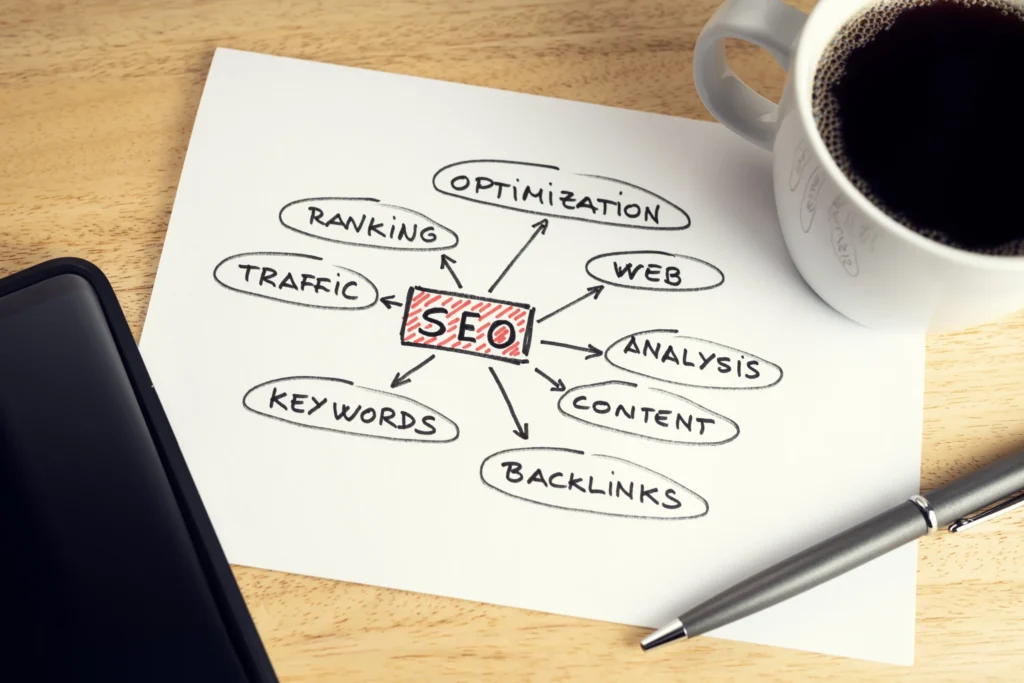
Once your SEO strategy goals are in place, you need to know if they’re working. That’s where tracking and KPIs come in.
At Vibe Branding, we build custom dashboards for our clients using tools like Google Analytics, Google Search Console, and Semrush. We’re not just watching vanity metrics—we focus on what matters.
The core KPIs we use include:
- Organic traffic volume
- Keyword rankings for goal-specific terms
- Bounce rate and time on page
- Conversion rate from organic traffic
- Backlink growth and domain authority
We track these KPIs monthly and break them down by goal type—whether it’s content, technical SEO, or link-building. One of our ecommerce clients set a goal to increase sales from organic traffic by 15% in 6 months.
We tracked everything from product page views to cart completions. By month four, we were ahead of schedule.
Here’s a basic view of how we tie tools to goals:
SEO Goal | Tool Used | KPI Measured |
Increase blog traffic | Google Analytics | Sessions, pageviews |
Rank for new keywords | Semrush | Keyword position changes |
Improve conversions | GA4, Hotjar | Conversion rate, session replay |
Build authority | Ahrefs | Referring domains, DR score |
The secret is not just measuring, but acting on what you find. If traffic goes up but conversions stay flat, you know what to work on.
Data isn’t just reporting—it’s your next step.
When and How to Review and Adjust SEO Strategy Goals
One of the biggest lessons I’ve learned in my ten years of SEO strategy is that no goal is ever final. The search landscape changes constantly—new competitors emerge, Google updates its algorithm, or your business may pivot direction.
That’s why we always recommend reviewing your SEO strategy goals regularly. Monthly pulse checks are great, but deeper quarterly reviews can reveal patterns and progress that surface-level metrics miss.
For instance, one of our clients saw an unexpected dip in organic traffic for a key service page. At first glance, the page still ranked well for its main keyword.
But when we dug deeper, we realized that Google had started favoring video results for that query. We adjusted the goal—not just to maintain traffic, but to add optimized video content to the page.
Within six weeks, traffic bounced back, and dwell time even increased. Adjusting SEO strategy goals isn’t a sign of failure. It’s a sign of smart, agile marketing.
If a goal becomes irrelevant—maybe a product is discontinued or a keyword loses search volume—don’t hold on to it just to say you completed it. SEO isn’t about checking boxes.
It’s about serving your users and your business. We use what we call a “Goal Audit Framework” every 90 days:
- Is this goal still aligned with business outcomes?
- Are we seeing movement toward the goal?
- Has anything changed in the competitive landscape?
- Are new opportunities emerging we didn’t plan for?
By doing this, we make sure our SEO goals evolve with the business—and not the other way around.
Common Mistakes Businesses Make When Setting SEO Strategy Goals
Over the years, I’ve seen many businesses trip up by setting the wrong kind of goals—or by not setting any at all. One of the most common mistakes is confusing activity with results.
For example, I’ve seen teams celebrate publishing 20 blog posts in a month, but when we ask what those posts were meant to accomplish, there’s silence. That’s why SEO strategy goals are so crucial—they help you separate busywork from impact.
Another major mistake is setting goals that are too broad or too ambitious. “We want to rank #1 for everything in our industry” sounds great but is rarely achievable.
We once helped a new tech startup recalibrate their expectations. Instead of aiming for competitive terms like “CRM software,” we focused their content around niche topics their audience actually searched for—like “best CRM for nonprofits.”
That shift in goal-setting helped them grow fast and get qualified traffic. Some teams also fall into the trap of only tracking rankings.
While rankings are useful, they don’t always tell the full story. A keyword might rank high but get no clicks—or the traffic might bounce if the content doesn’t meet user expectations.
Without tying your goals to behavior metrics like click-through rates or conversion rates, you could be missing the bigger picture. Lastly, people often skip setting timeframes.
A goal without a deadline is just a dream. You need timelines to stay accountable and to measure whether your strategy is working in the short, medium, or long term.
Avoiding these mistakes will save you time, money, and frustration—and get you closer to your actual business goals.
Short-Term vs. Long-Term SEO Goals: Why You Need Both
When we work with clients at Vibe Branding, we always build both short-term and long-term SEO strategy goals into the roadmap. Why?
Because SEO is a marathon—but that doesn’t mean you can’t pick up some wins along the way. Short-term goals are usually tactical.
They might include fixing broken links, speeding up your site, or optimizing five existing blog posts. These are low-hanging fruits that can start showing results in a few weeks.
One of our local clients saw a 30% increase in visibility just by optimizing their title tags and headers. That’s the power of short-term execution.
Long-term goals, on the other hand, focus on bigger shifts—building authority, owning a topic cluster, or ranking on page one for competitive keywords. These can take 6 to 12 months (or more), but they’re where the real ROI comes in.
For example, we worked with an online education company to dominate the keyword cluster around “data analytics bootcamp.” It took almost a year, but now they own that space and are bringing in thousands of qualified visitors each month.
Here’s how we often describe the difference to clients:
- Short-term = optimization
- Long-term = positioning
You need both types of goals working in tandem. Short-term goals build momentum and improve user experience.
Long-term goals build brand authority and lasting search equity. One supports the other, and both keep your SEO strategy balanced and resilient.
The Role of Content, Technical SEO, and Link Building in Reaching Your Goals
If SEO strategy goals are the destination, then content, technical SEO, and link building are your three main vehicles to get there. Each plays a unique and vital role in how you reach your goals—and we always make sure our clients understand the difference.
Content is your voice. It’s how you communicate with both users and search engines.
Every piece of content—from blog posts to landing pages—should be created with a purpose that ties back to a specific goal. If your goal is to increase organic leads, then your content should address pain points and lead visitors toward conversion.
We call this “goal-first content creation,” and it’s a game-changer. Technical SEO is the foundation.
No matter how good your content is, it won’t rank if search engines can’t crawl or index it properly. We’ve seen incredible content buried simply because of slow page speeds, missing meta tags, or mobile issues.
That’s why technical audits are one of our first tasks when starting any new project. Fast, clean, and structured websites outperform sluggish, cluttered ones—period.
Then there’s link building—your credibility. Google still relies heavily on backlinks to assess authority.
But not all links are created equal. A single backlink from an industry publication can do more for your rankings than 100 random directory listings.
We focus on building links through digital PR, guest blogging, and high-value content that others naturally want to reference. Each pillar supports the others.
Technical SEO helps content get seen. Great content earns links.
And strong links boost your authority, which in turn helps your content climb higher. When all three are aligned with your SEO strategy goals, the results are powerful and sustainable.
Final Word: Why SEO Strategy Goals Are Non-Negotiable for Growth
After ten years in this field, one thing has become absolutely clear: businesses that set clear, intentional SEO strategy goals consistently outperform those that don’t. Period.
These goals are what give your SEO purpose. They keep your team aligned, your decisions focused, and your success measurable.
When we work with brands at Vibe Branding, whether it’s a startup or an established company, our first priority is to define SEO goals that matter. Not fluff.
Not guesses. Real targets that move the needle.
We don’t chase keywords just for the sake of it—we build strategies that lead to growth. And here’s the thing: SEO doesn’t have to be confusing.
When your goals are SMART, your tools are in place, and your team is aligned, SEO becomes one of the most powerful levers for long-term business success. It’s not just about rankings—it’s about revenue, reputation, and reach.
So if you’ve been dabbling in SEO without direction, now’s the time to take it seriously. Set your SEO strategy goals.
Align them with your business. Track them like a pro.
And most importantly, revisit them regularly so your strategy evolves as your business grows.
The results will speak for themselves.