What Does “SEO and Business Objectives” Mean?
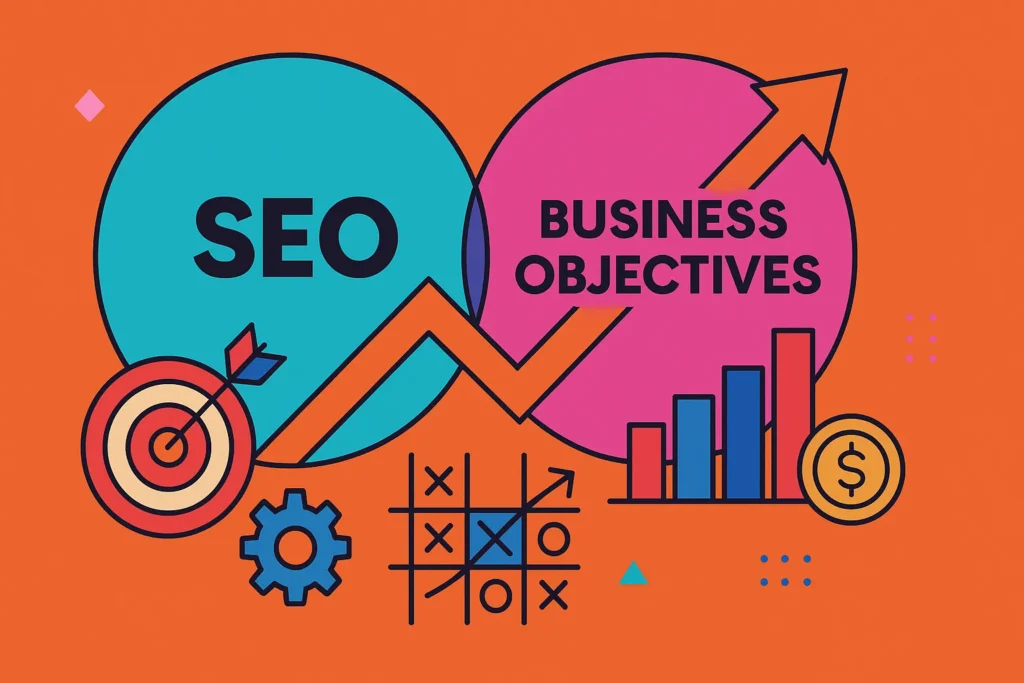
SEO and business objectives means making sure your SEO work is supporting your bigger business goals. Instead of just trying to rank for random keywords or increase traffic, you’re aiming to get results that help your company grow—like more sales, brand visibility, better leads, or market expansion.
It’s about making SEO part of your company’s overall plan, not just an isolated activity done in the background.
TL;DR – Quick Summary
- Learn how to align your SEO efforts with business goals for better ROI
- Discover why SEO should never live in a silo
- Understand what business objectives really mean in digital strategy
- Get real-world tactics we use at Vibe Branding to bridge SEO and business success
- Learn how to set measurable SEO goals that move the needle
- Understand how to track progress, show results, and bring teams together
- Explore case studies and personal insights from 10+ years in digital marketing
Why Business Objectives Matter in SEO
When I first started Vibe Branding over a decade ago, we were like many other agencies—focused on traffic, rankings, and the usual SEO metrics. But something didn’t feel right.
We’d help clients rank #1 for keywords, yet they’d come back and say their sales hadn’t improved. That’s when it hit me: SEO success isn’t just about visibility.
It’s about alignment. Once we began tying SEO to business objectives—things like increasing demo signups, reducing churn, or launching into new markets—that’s when our clients started seeing the real value.
Understanding business objectives is the first step. These could be revenue goals, product launches, entering new markets, or increasing brand awareness.
SEO supports all of these—when done right. And when SEO strategies match business priorities, the entire engine runs smoother. We’ve used this philosophy across countless campaigns for clients in tech, e-commerce, healthcare, and more.
And every time, it led to more meaningful outcomes than just chasing keywords.
Aligning SEO With Short- and Long-Term Business Goals
To align SEO with both short-term and long-term goals, we use a system. Short-term SEO goals might focus on ranking new blog posts for a product launch, while long-term goals might target building topical authority or acquiring backlinks from industry leaders.
Let me give you a real example: one of our B2B SaaS clients wanted to grow demos in Q2. We focused SEO around bottom-of-funnel content—pages optimized for “product alternatives,” “product vs competitor,” and “use case” queries.
Traffic didn’t explode, but conversions did. That’s alignment in action. Long-term, we planned educational content and evergreen topics to support their growth for the next 12 months.
Having that balance between quick wins and sustainable gains is key. We also review progress monthly so we can course-correct, which is something I recommend every brand builds into their SEO workflow.
Measuring the Impact of SEO on Business Goals
When it comes to measuring the impact of SEO on business objectives, most people think of traffic. But that’s just the tip of the iceberg. At Vibe Branding, we track a mix of SEO metrics (like keyword rankings, organic impressions, CTR, and backlinks) and business metrics (like conversions, customer acquisition cost, and revenue from organic leads).
We use this combined data to prove ROI—not just to ourselves, but to our clients’ C-suites.
Metric Type | SEO Metric | Business Objective It Supports |
SEO | Organic traffic | Brand visibility, content reach |
SEO | Keyword rankings | Product discovery, awareness |
Business | Conversion rate from SEO traffic | Lead generation, sales |
Business | Revenue from organic leads | ROI, LTV/CAC improvement |
SEO | Backlink growth | Authority building, PR reach |
Using these metrics, we’ve helped clients discover which keywords actually drive revenue and which ones are just vanity metrics. That clarity makes it easier to get leadership buy-in—and budget.
Mistakes Businesses Make by Isolating SEO
A common mistake I’ve seen time and time again is separating SEO from business planning. When your SEO team works in a vacuum, they might chase traffic from low-intent keywords or miss out on business opportunities.
I’ve worked with companies that spent months targeting blog content their audience didn’t care about—all because SEO wasn’t looped into the marketing roadmap. Another big one: reporting only on keyword rankings or impressions.
This sounds impressive but means nothing if those visitors don’t convert. What your leadership wants to know is: How is SEO helping us grow?
That’s the only question that matters. When SEO is integrated into your business goals from the beginning, you avoid wasting time and money.
Building Keyword Strategy Around Business Priorities
A huge turning point in any SEO strategy is how you choose your keywords. Back when we worked with a fast-growing ecommerce brand, we didn’t just look for high-volume terms.
We started with their product roadmap and customer journey. Then we used tools like Ahrefs and Google Trends to find keywords that matched buyer intent—like “best [product] for [specific use]” or “affordable [product category] for students.”
This keyword strategy did two things: it drove relevant traffic, and it supported business priorities like promoting seasonal items or launching a new collection. Your keyword list should reflect what your business is trying to achieve—not just what’s trending.
That’s how we use SEO to drive real business outcomes.
Communicating SEO in Business Terms
Now let’s talk about communication. One thing I always stress with clients is that you need to report SEO in a way business leaders understand.
That means skipping the technical jargon and focusing on outcomes. When we present SEO results, we show them how our work helped increase MQLs (marketing qualified leads), reduced CAC (customer acquisition cost), or improved funnel velocity.
In our monthly reports, we make sure to include:
- New organic leads by landing page
- Ranking improvements for high-converting keywords
- Comparison of organic traffic to conversions
- Organic revenue and ROI (if tracked in CRM)
Telling the SEO story in business terms makes everyone care more. And when you tie efforts to revenue or cost savings, getting approval for more SEO resources becomes much easier.
Tools and Frameworks to Track Business Outcomes
We also rely heavily on tools and frameworks to connect SEO with business outcomes. We use ClickUp Goals to align campaigns with objectives and track results over time.
Google Search Console and GA4 give us a clean look at traffic and behavior, while HubSpot shows us the business impact. When we combine all this data, we get a full picture—from search term to sale.
Our internal framework looks like this:
- Goal: Increase product demo signups by 20% in Q3
- Strategy: Rank for bottom-funnel product comparison keywords
- Tactics: Publish 4 optimized comparison pages + 10 backlinks
- Metrics: Keyword rankings, CTR, demo form submissions, demo-to-paid conversions
Each SEO action is tied to a measurable outcome. That’s how we keep our SEO work focused and aligned.
This clarity helps not only our team, but our clients’ sales and product teams understand why SEO matters.

What an SEO-Business Aligned Roadmap Looks Like
Creating a roadmap that aligns SEO with business objectives isn’t just about a one-time setup—it’s about planning, feedback, and iteration. We start each quarter with a strategy call that includes marketing, sales, and product teams.
That way, we understand what everyone’s working on and where SEO can help. We then create quarterly SEO goals and match them to OKRs.
If the sales team wants to grow in a new region, we create content for that market. If product is launching a new feature, we optimize the product page and build awareness through blogs.
It’s all connected. Every task on our roadmap is color-coded by objective, so we’re always clear on what goal it supports.
And yes, we revisit the roadmap every month to see what’s working, what’s not, and what needs to shift. SEO that aligns with business doesn’t stay static—it evolves with the business itself.
Collaborating Across Teams for Better Results
One of my favorite parts about integrated SEO is the collaboration it creates. We’ve worked with teams where customer support helped us discover high-intent questions to answer with SEO blogs.
Sales teams shared objections that we turned into valuable SEO landing pages. Even dev teams helped us speed up page loads for SEO and UX improvements.
When everyone understands how SEO supports their work—and how their work fuels SEO—you create a real flywheel of growth. At Vibe Branding, we’ve built systems that make cross-department collaboration easy. SEO is no longer “just a marketing thing.”
It’s a company-wide effort.
Case Study: Bringing It All Together
Let me give you a real-world example that brought all of this together. A healthcare tech company came to us because their traffic was high but leads were low.
Their business objective was to increase demos for a specific software tool by 30% in 6 months. We aligned SEO around that goal. We started by revising old blog content to focus on real user problems and CTAs.
Then, we optimized their product pages with conversion-friendly copy and internal links. We also built a content cluster around relevant keywords, like “[problem] solutions for clinics” and “how to improve [specific workflow].”
The result? Their organic leads jumped by 38% in five months, and demo bookings doubled.
The CEO told us it was the first time they’d seen SEO tied to real pipeline results. That’s what we mean by connecting SEO and business objectives.
Final Thoughts
After 10+ years at Vibe Branding, I’ve seen that SEO works best when it supports business goals—not when it operates in a silo. When SEO strategies are aligned with clear objectives like growth, sales, or retention, results become more meaningful and measurable.
Integrating SEO into company-wide planning, collaborating across teams, and adjusting tactics monthly keeps everything moving forward. Whether your goal is to scale, convert, or compete—connecting SEO and business objectives is the smartest move you can make.
Here’s a glimpse at how we evaluate progress month-to-month:
Review Area | What We Evaluate | How It Ties to Objectives |
Content Performance | Top traffic pages and time on page | Audience intent and engagement |
Conversion Flow | Where organic visitors drop off | Sales funnel efficiency |
New Keywords Ranked | Relevance to target customers | Brand visibility and market share |
Link Quality | Referring domain trust and relevance | Domain authority and industry trust |
Goal Progress | KPI trends vs. goal timeline | Overall business impact |