What Are SEO Marketing Objectives?
SEO marketing objectives are the specific goals you set to improve your website’s visibility in search engines and drive business growth. These aren’t vague wishes like “get more traffic.” They are focused, trackable, and tied to a larger strategy.
At Vibe Branding, we’ve helped countless clients define and hit SEO marketing objectives that move the needle. From boosting qualified leads to increasing brand visibility, the right objectives can make or break your digital efforts.
If you don’t know what you’re aiming for, how will you know if you hit it?
TL;DR: What You’ll Learn in This Post
- What SEO marketing objectives are and why they matter
- How to align SEO goals with your business strategy
- Specific examples of measurable SEO marketing objectives
- Tools and metrics to track SEO goals effectively
- How we set smart goals at Vibe Branding based on a decade of experience
- Avoiding common mistakes and understanding differences between small and large business goals
Why Clear SEO Marketing Objectives Matter
When I started Vibe Branding over a decade ago, one of the most common problems I saw was businesses pouring money into SEO without clarity. SEO can’t just be about “ranking.”
It has to serve a business goal. Whether it’s getting more form fills, increasing online sales, or building awareness in a crowded market, SEO marketing objectives make sure you’re not just busy — you’re effective.
We use these goals to focus our strategy, report on success, and make smart decisions. Without them, it’s like running a race without a finish line.
Goals give you purpose, direction, and momentum.
Aligning SEO Goals With Business Strategy
At Vibe, we always ask new clients one simple question: “What does success look like for your business?” That answer tells us how we shape their SEO marketing objectives.
For example, if you’re a SaaS company looking to grow monthly subscribers, your objective may be to rank for bottom-of-funnel search terms that drive demo requests. If you’re a local business, it might mean dominating the map pack for service keywords.
Our job is to bridge your business goals with SEO performance. That’s where alignment happens.
Your SEO shouldn’t live in a vacuum. It should be directly connected to your revenue and retention goals.
Examples of Measurable SEO Marketing Objectives
When I work with clients, we always map out goals that are measurable. One e-commerce brand we worked with aimed to increase organic sales by 30% in six months.
Another client, a law firm, set a goal of ranking in the top 3 for “personal injury attorney Long Island” within four months. These aren’t dreams—they’re objectives backed by research and strategy.
Here are a few more real examples from our work:
Objective | Description | Timeline | Success Metric |
Increase organic traffic by 25% | Publish and optimize 12 new blog posts targeting informational keywords | 6 months | Google Analytics traffic report |
Improve bounce rate by 15% | Redesign core landing pages based on heatmap and user behavior analysis | 90 days | GA4 bounce rate report |
Acquire 20 backlinks from high-authority domains | Create high-value, linkable assets and run an outreach campaign | 3 months | Ahrefs backlink count |
Rank #1 for local keyword | Focus on technical SEO and local citations for [target keyword] | 4 months | Google SERP position |
Boost organic conversions by 40% | A/B test SEO landing pages with updated CTAs and UX | 6 months | CRM lead count + GA4 |
When goals are this specific, everyone on the team knows what to do and how to measure success. These aren’t just random ideas—they’re tied to business outcomes.

How to Set Realistic, Data-Driven SEO Goals
I’ve seen businesses get discouraged because they set goals based on what they “hope” will happen instead of what’s realistic. At Vibe, we use the SMART framework for SEO marketing objectives: Specific, Measurable, Achievable, Relevant, and Time-bound.
Before we commit to a goal, we do keyword research, audit the competition, analyze your domain authority, and calculate the size of the opportunity. If your domain is new, you’re probably not going to outrank Amazon next month.
But you can dominate long-tail keywords and build from there. Realism doesn’t mean thinking small. It means being strategic.
Your goals should push you forward while staying grounded in what’s possible with your resources.
The Tools and KPIs We Use to Track SEO Success
Our agency lives in tools like Google Search Console, GA4, Ahrefs, and Screaming Frog. These platforms show us what’s working and what needs a pivot.
For example, if one of our SEO marketing objectives is to increase click-through rates, we’ll monitor Search Console for impression-to-click ratios on core pages. If it’s backlinks, we use Ahrefs to track new referring domains.
KPI tracking is critical. Some of our go-to SEO KPIs include:
- Organic traffic growth (GA4)
- Keyword rankings (Ahrefs, Semrush)
- Bounce rate (GA4)
- Conversion rate (GA4 + CRM)
- Page speed and Core Web Vitals (PageSpeed Insights)
- Backlink profile growth (Ahrefs)
We set monthly benchmarks, track trends, and adjust based on performance. The key is transparency: you can’t manage what you don’t measure.
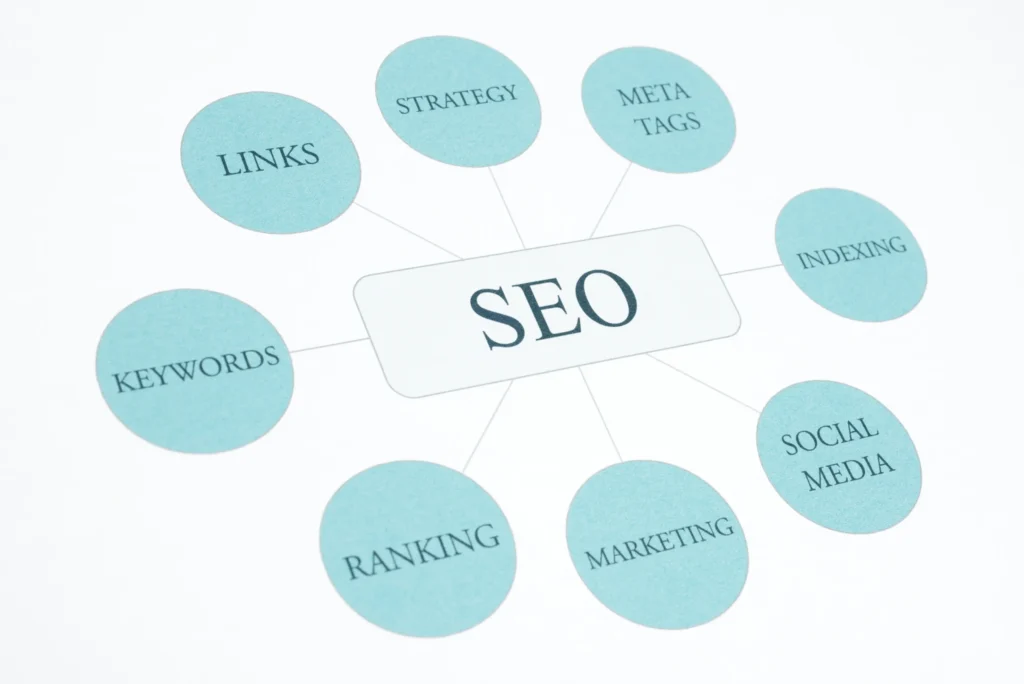
Keyword Research: The Foundation of All Great SEO Goals
Every objective we set starts with one thing: keyword research. Without it, you’re flying blind.
We use tools like Ahrefs and Google Keyword Planner to find the terms your audience is actually searching for. Then we analyze their intent.
Are they informational, navigational, or transactional? That tells us where the keyword fits in your funnel.
For example, “best CRM tools” is top-of-funnel. “Buy CRM software” is bottom-of-funnel.
We match those terms to content types and define goals accordingly. If you want more leads, you need to target commercial keywords.
If you want brand authority, target educational ones. Keyword research isn’t just about volume—it’s about value.
Why SEO Goals Must Be Reviewed and Adjusted
Here’s something I tell every client: SEO isn’t set-and-forget. It evolves.
So should your goals. At Vibe Branding, we hold monthly strategy calls to review all current SEO marketing objectives.
If we’re seeing slower progress than expected, we investigate why. Maybe competition increased.
Maybe search intent changed. Maybe we just need to create stronger content.
Whatever the case, we update our action plan. Reviewing goals helps us stay accountable and keep momentum.
It also prevents burnout. There’s nothing worse than chasing a goal that’s no longer aligned with your audience or business.
How SEO Marketing Objectives Drive ROI and Lead Generation
When I look back on our most successful campaigns at Vibe Branding, there’s always one thing they have in common: well-defined, ROI-focused SEO marketing objectives. These goals didn’t just focus on getting more traffic — they focused on getting the right traffic.
And that’s what really moves the needle for businesses. I remember working with a B2B tech client who was struggling with organic lead quality.
We helped them reframe their goals around bottom-funnel keywords and created optimized landing pages with better CTAs. The result?
A 60% increase in qualified leads within five months — not just more people, but better people. Lead generation through SEO works because it captures users when they’re actively looking for a solution.
It’s not disruptive like a paid ad; it’s helpful. That means higher intent, better conversions, and more trust from day one.
When your objectives are tied to outcomes like cost per lead or revenue per visitor, you suddenly see how SEO becomes one of your most cost-effective acquisition channels. It’s not just a nice-to-have anymore — it’s a profit lever.
Even for ecommerce, we’ve seen clients double their sales simply by optimizing product descriptions and targeting long-tail purchase-intent keywords. The results speak for themselves: SEO with the right objectives is not a gamble — it’s an investment with compounding returns.
Mistakes to Avoid When Setting SEO Marketing Objectives
One of the biggest traps I see businesses fall into is setting goals that are too vague or too ambitious. “We want to rank #1 on Google” sounds impressive — but for what keyword?
In what timeframe? Why does that ranking matter for your business?
Without that context, it’s just noise. I’ve had clients come to us frustrated because their old agency promised rankings that had zero impact on their bottom line.
That’s not strategy. That’s vanity.
Another common mistake is chasing traffic volume over intent. Just because a keyword gets 10,000 monthly searches doesn’t mean it’ll bring you sales.
A long-tail keyword with 300 monthly searches might convert at a much higher rate because it aligns better with what your customers are actually looking for. Overlooking competitor research is another misstep.
Before setting your SEO marketing objectives, always analyze who’s currently ranking and why. Are you realistically positioned to compete?
What can you do better? Ignoring this will waste your time and resources.
And finally, too many businesses set goals without building the infrastructure to support them. If you want to double traffic, can your site handle that?
Are your forms optimized to convert it? Are your internal teams prepared for the growth?
Avoiding these mistakes has helped us guide clients toward sustainable, meaningful SEO wins for over 10 years — and I promise, it makes all the difference.
Small Business vs. Enterprise SEO Objectives
As someone who’s worked with both startups and global brands, I can tell you: SEO marketing objectives aren’t one-size-fits-all. The goals you set should reflect your size, scope, and resources.
For small businesses, it’s about focus. You likely don’t have the bandwidth to chase 50 keywords across multiple channels.
That’s why we recommend targeting high-conversion, local-intent terms first. Start where you can win.
One HVAC company we worked with in Queens only had budget for a small campaign. We focused on just three keywords and optimized their Google Business Profile.
Within weeks, their phone was ringing more than ever. For enterprises, it’s a different game.
These businesses often have thousands of indexed pages, international audiences, and internal silos. SEO goals here need to reflect cross-functional coordination, broader keyword maps, and more robust analytics.
At Vibe, we break enterprise goals into sub-goals by department — brand, product, support, etc. — and track performance separately. We might create SEO goals for everything from local market dominance to knowledge base optimization.
It’s complex, but when orchestrated well, it scales beautifully. The key is understanding your playing field.
Whether you’re a solopreneur or a Fortune 500, your SEO marketing objectives should stretch your potential — not your sanity.
Conclusion: The Power of Intentional SEO Goal Setting
After 10 years in digital marketing, one thing I know for certain is this: success in SEO doesn’t happen by accident. It’s the result of clear vision, smart planning, and relentless execution.
SEO marketing objectives are not just another checkbox — they’re the blueprint for meaningful growth. When done right, they guide every action, every keyword, and every campaign with purpose.
At Vibe Branding, we’ve built our reputation on helping brands rise with precision — not just noise. We don’t chase trends or traffic for the sake of it.
We dig deep, get strategic, and define goals that truly reflect what success looks like for you. Whether you’re aiming to grow your organic leads, increase ecommerce sales, or become a thought leader in your space, the path forward starts with knowing what you’re aiming for — and building a roadmap to get there.
And that’s what we do best.